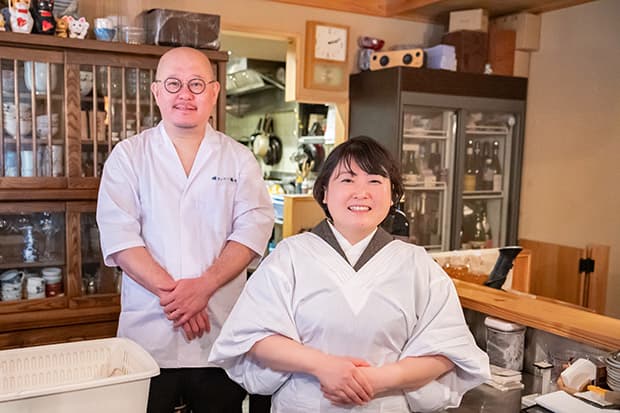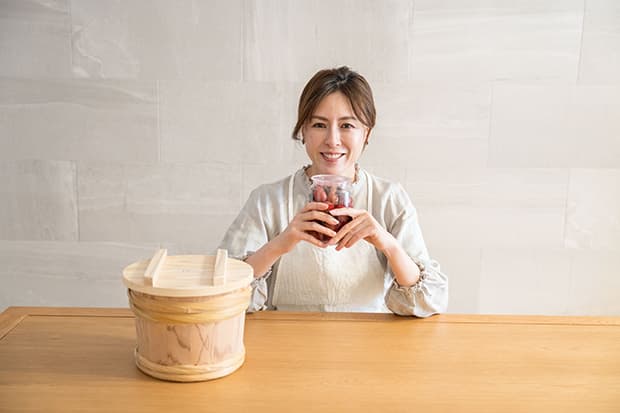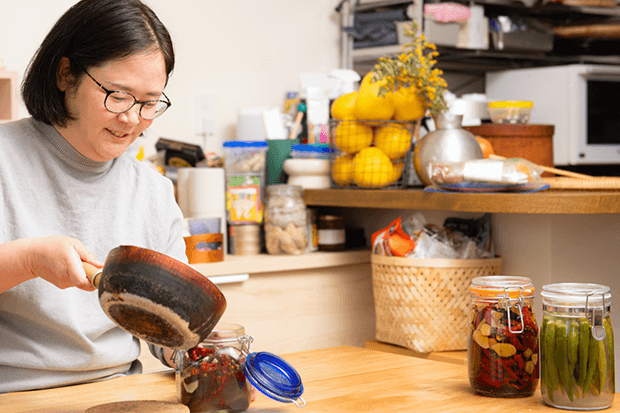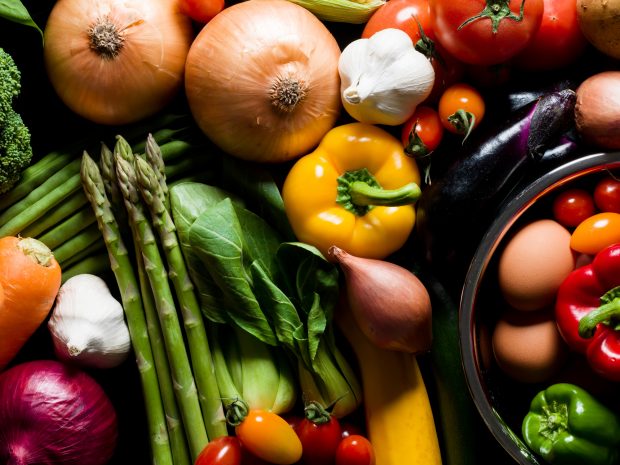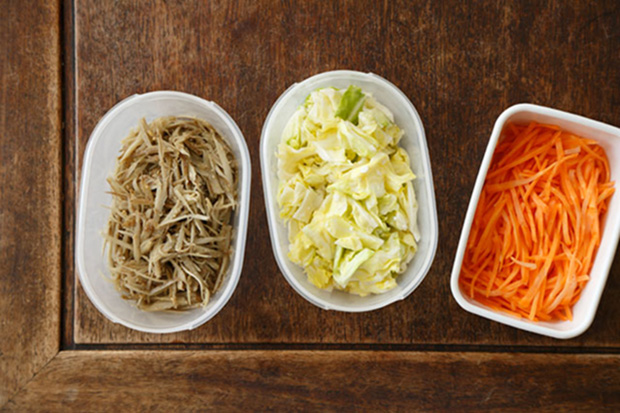
Culinary expert Setoguchi Shiori lives in a quiet Tokyo residential neighborhood with her husband and son. Her boy, who has just started junior high school, is going through a growth spurt and has a ravenous appetite. Shiori preps ingredients whenever she finds a moment so that she can get dinner ready as soon as he arrives home from school. She rinses the rice in the morning, drains it in a colander, then sticks it in the fridge. She pre-seasons the meat or fish for the main dish. And she always preps the vegetables in advance. That way, cooking a meal goes much more smoothly.
“When preparing leaf vegetables like komatsuna (Japanese mustard spinach), I separate the leaves and stalks after washing for ease of use, then put them in a storage container. I also find it handy to chop vegetables for toppings — banno-negi scallions, mitsuba (Japanese wild parsley), coriander — in advance and store them. In either case, I line the container with a paper towel, so the vegetables stay nice and moist. I julienne cabbage and carrots and rub them in salt. Vegetables prepped this way taste good on their own, or they can be served with other ingredients in small bowls or used in stir-fries or simmered dishes. They can be incorporated into a wide variety of dishes, because they’re seasoned with nothing but salt.”
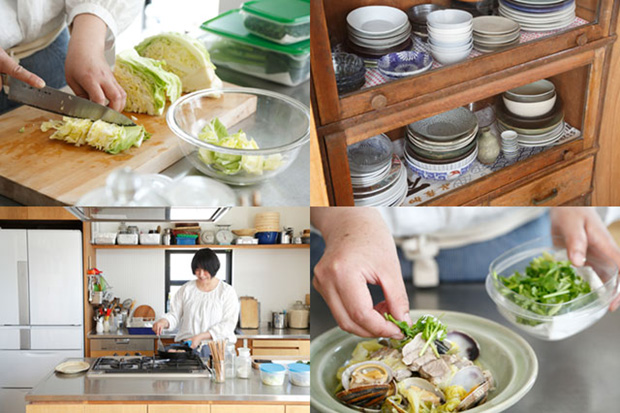

Using fermented seasonings for prepping enhances vegetables’ flavor.
The two fermented seasonings Shiori uses most often for prepping vegetables are miso and shio koji (salted rice malt).
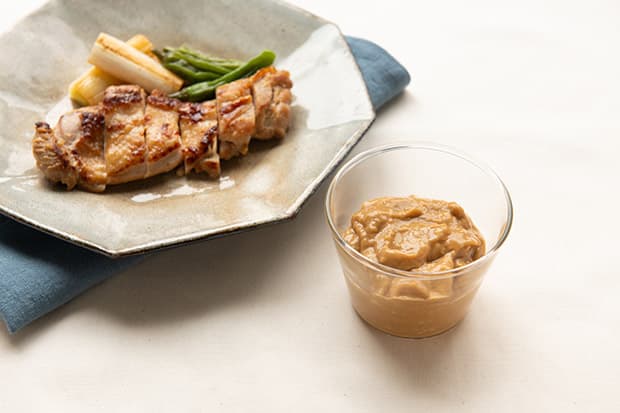
“The power of fermentation enhances the flavor of seasonal vegetables. My son likes his food simple, so I serve him vegetables on their own, instead of combining them with other ingredients, and season them to be eaten as they are. Shio koji and miso both have a natural umami, so ingredients seasoned with them are highly versatile. A staple in our home is miso kimpira made with burdock root. I put it in ginger-fried pork or mix it with minced meat to make hamburger steaks. I’ll sometimes simmer the hamburger steaks in tomato sauce. Try different things, and you may discover an appealing new taste. It’s not as hard as you think.”
Here Shiori shares two techniques for prepping vegetables — burdock root miso kimpira, and cabbage in shio koji — along with a recipe incorporating each. Why not give these handy menu suggestions a try? Discover how the power of miso and shio koji makes vegetables taste even better!
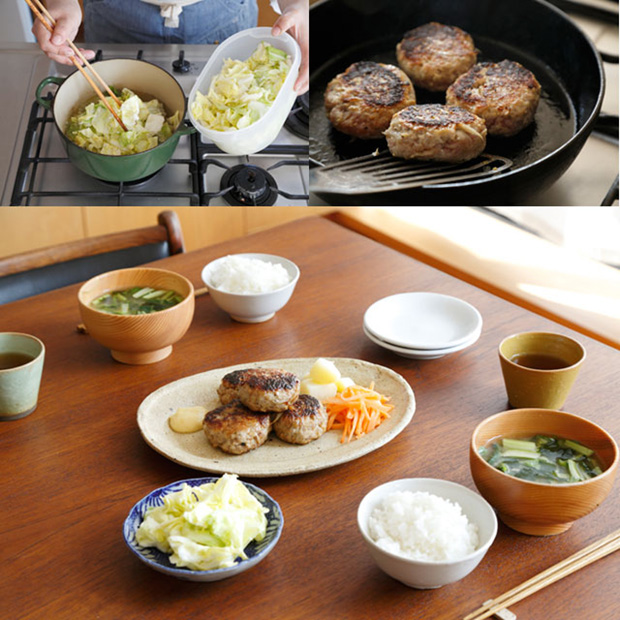
Setoguchi Shiori’s advance prep instructions & recipes for vegetables
<Burdock root miso kimpira>
Kimpira means sautéed and simmered root vegetables. This particular version is seasoned with just miso and mirin (sweet cooking sake), resulting in a rich flavor that beautifully complements white rice. And the burdock root possesses its own pronounced umami. A real lifesaver that can be incorporated into a wide variety of dishes.
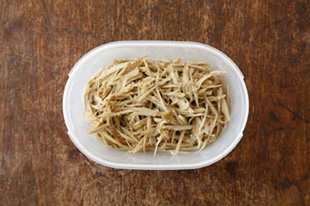
Ingredients for an easy-to-prepare batch
1 burdock root (200 g)
½ tbsp. vegetable oil
Seasoning ingredients
Just under 2 tbsp. miso (Plus Koji Additive-Free Koji Bijin)
½ tbsp. mirin (sweet cooking sake)
Instructions
【1】Shave the burdock root into thin slices. Soak in water for 2 minutes and drain in a colander.
【2】Heat the oil in a frying pan and sir-fry the burdock root over medium-high heat.
【3】Once everything is coated in oil, add the flavorings and stir-fry to evaporate the moisture.
Keeps for 3–4 days in the fridge.
●Serving suggestions
Use as a topping for vegetable salads or mix with freshly cooked white rice. It also makes a nice ingredient in stir-fried vegetables or ginger-fried pork: the miso adds a delicious twist.
●Next, a recipe made with burdock root miso kimpira:
<Hamburger steaks stuffed with burdock root miso kimpira>
A Japanese-style dish bursting with flavor. Because the kimpira is already well seasoned, adding a little miso is all that’s needed to perfect the taste. For an extra twist, simmer in tomato sauce: you’ll love the taste!
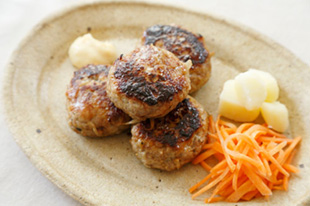
Ingredients for 2 servings
Hamburger ingredients
60 g burdock root miso kimpira
220 g ground pork
1 tbsp. miso (Plus Koji Additive-Free Koji Bijin)
½ a beaten egg
Pinch of black pepper
15 g breadcrumbs
1 tbsp. milk
½ tbsp. vegetable oil
The sides of your choice: carrots rubbed with salt, fluffy boiled potatoes, etc.
Miso mayonnaise
1 tsp. miso (Plus Koji Additive-Free Koji Bijin)
2 tbsp. mayonnaise
Instructions
【1】Place the breadcrumbs and milk in a bowl and let sit for 5 minutes. Mix together the miso mayonnaise ingredients.
【2】Add the hamburger ingredients to the bowl and mix in. Once the mixture begins to thicken, form into 4 equal-sized circular patties.
【3】Heat the oil in a frying pan and fry the patties over medium heat. Flip them over after they turn brown. Once browned on both sides, add 80 cc water, cover with a lid, and cook until all the water is gone.
【4】Dish up. Serve with the sides of your choice and garnish with the miso mayonnaise.
●The featured miso:
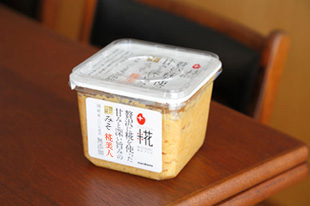
<Plus Koji Additive-Free Koji Bijin>
A popular item in the Plus Koji series, this additive-free miso is made with 100% domestically grown Japanese rice and generous amounts of rice koji. It combines the natural sweetness of miso with rich umami notes. Plus Koji Additive-Free Koji Bijin
<Cabbage in shio koji>
A great way to enjoy fresh cabbage of the season, having the same munchable quality as lightly pickled cabbage. It’s a cinch to prep: simply dress the leaves with the all-purpose seasoning shio koji. And the beauty of it is, it can be adapted to a wide range of dishes depending on how you cut it.
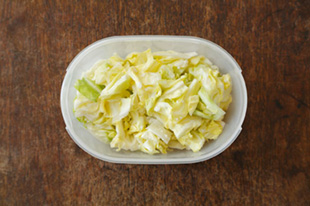
Ingredients for an easy-to-prepare batch
¼ head cabbage
2 tbsp. Plus Koji Shio Koji
Instructions
【1】Wash the cabbage and drain in a colander. Chop into large pieces.
【2】Place the cabbage and shio koji in a bowl and mix together. Let set for 15 minutes.
Keeps for 2–3 days in the fridge.
●Serving suggestions
Use as is in soups and stir-fries. It also makes a great filling for shumai or gyoza dumplings or menchi-katsu (breaded and fried ground meat patties). Simply mince and squeeze out the moisture.
●Next, a recipe made with cabbage in shio koji:
<Stewed cabbage in shio koji with pork and asari clams>
An exquisite soup bursting with umami goodness from the shio koji and the other ingredients. It’s topped with a sprinkling of coriander for an ethnic touch. For a Japanese twist, replace the coriander with banno-negi scallions or mitsuba (Japanese wild parsley).
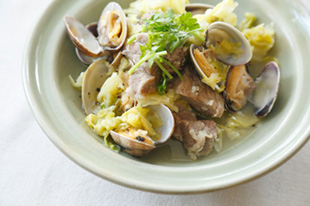
Ingredients for 2 servings
All the cabbage in shio koji you’ve prepped
250–300 g block of pork shoulder
10 asari clams
1 tbsp. olive oil
1 cup water
¼ cup sake
1 tbsp. Plus Koji Shio Koji
Pinch of black pepper
Coriander to taste
Instructions
【1】Cut the pork into bite-size pieces. Soak the asari clams to remove the sand.
【2】Heat the olive oil in a heavy pan. Cook the pork until browned all over.
【3】Add the water and sake. Once they come to the boil, turn the heat to low and skim off the scum. Add the cabbage and the shio koji, cover with a lid, and simmer for 20 minutes.
【4】Once the pork is tender, add the clams and cover with a lid. Simmer until the shells open.
【5】Dish up. Grind on black pepper and top with the chopped coriander.
●The shio koji used:
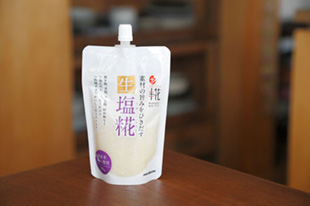
<Plus Koji Shio Koji>
A fresh shio koji (salted rice malt) that brings out the best in the ingredients. This all-purpose seasoning can be used in place of salt in nimono (simmered dishes), aemono (dressed dishes), and stir-fries. With its natural umami flavor, it takes delicious to a new level! Plus Koji Shio Koji