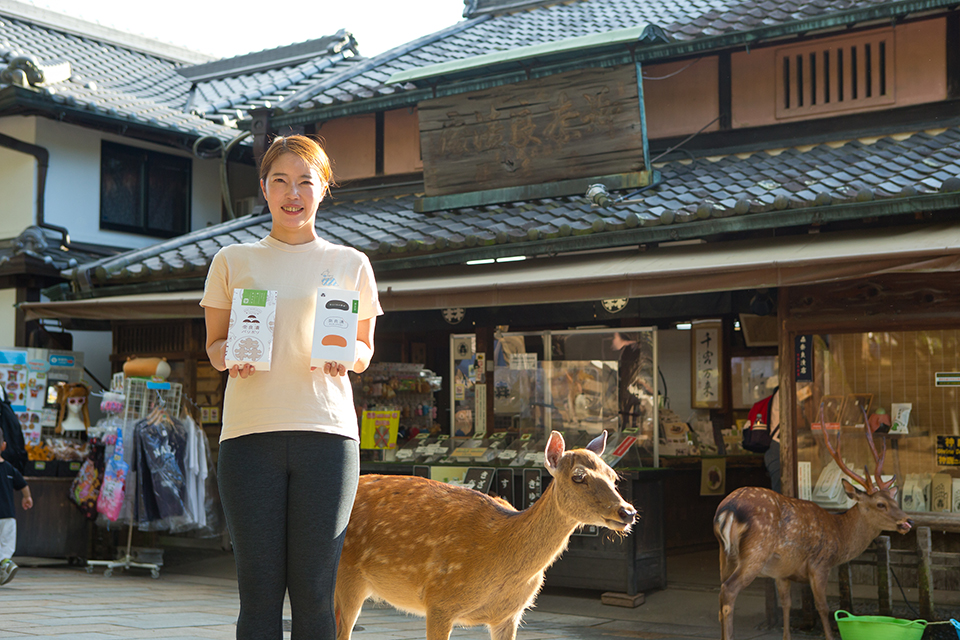
Among Nara’s many tourist attractions steeped in history and culture from time immemorial, Todai-ji temple stands out as especially popular. Mori Mariko, the fifth-generation owner of Mori Naraduketen, a store located along the approach to the temple, is very active in sharing new ways to enjoy Nara-zuke pickles on social media and in developing saké pairing collaborations with six local saké breweries.
Driven by a desire to further promote the appeal of Nara-zuke, Mori exhibits her store’s Nara-zuke at saké events in Japan and abroad. We spoke with her about her challenging endeavors.
Nara-zuke have always been sustainable, then and now! Powered by fermentation, these pickles provide health and beauty benefits
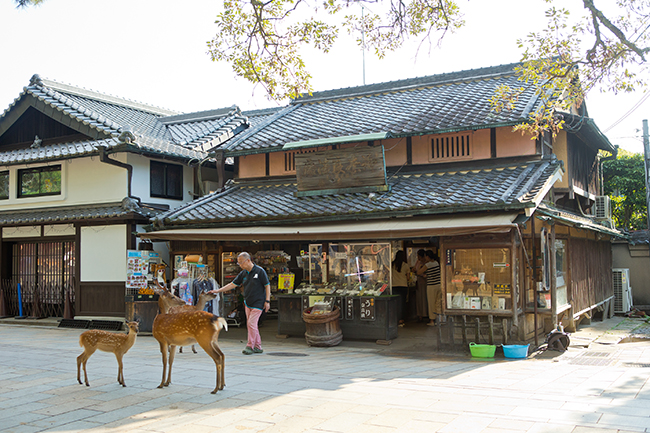
Mori Naraduketen is located close to the Great South Gate of Todai-ji temple. Founded in 1869, this long-established store has been beloved by pilgrims and locals for over 150 years. Deer are regulars here too, and their calm demeanor in front of the store puts passers-by at ease. More and more tourists from overseas now come to visit Todai-ji temple, some of whom buy Nara-zuke as souvenirs on their way home.
“With people all over the world becoming more conscious of their health, miso and soy sauce have become well-known overseas as Japanese fermented foods,” says Mori. “However, Japanese pickles, despite also being fermented foods, are still relatively unknown. As someone who carries on the tradition of making Nara-zuke, I want to promote their benefits to a wider audience.”
If people don’t know what a food is, they won’t buy it or even remember it. That’s why if tourists have made the effort to come to Nara, Mori wants them to understand Nara-zuke as a part of Japan’s food culture. To this end, Mori has produced an English-language leaflet that highlights her products and their benefits. She has also launched an English website, promoting both Nara-zuke and the culture of pickles as a whole.
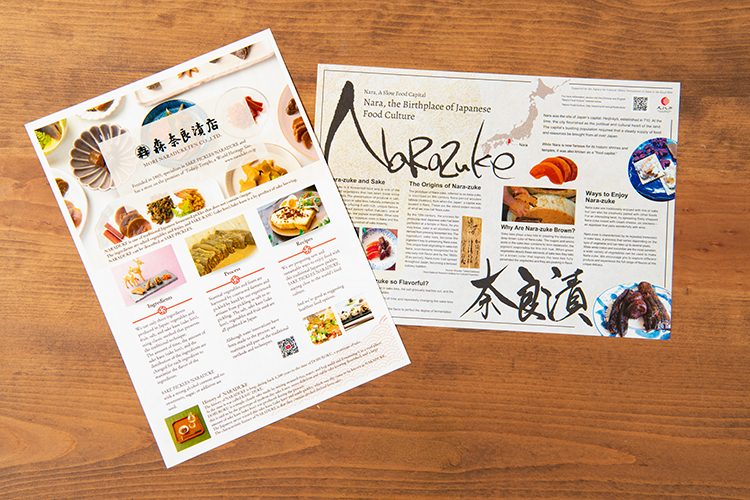
This English-language leaflet explains the history of Nara-zuke, their ingredients, and how they are made, as well as the best way to eat them. The leaflet is packed with thoughtful information for overseas guests trying Nara-zuke for the first time.
“At Mori Naraduketen, we use only domestic vegetables and fruits, natural salt from Ako in Hyogo Prefecture, and saké lees for our Nara-zuke. We continue to follow traditional production methods, adding absolutely no mirin [rice wine] lees, sugar, or sweeteners. Saké lees are the residue left after pressing the mash during saké production. Rather than letting the saké lees go to waste, we upcycle it by repeatedly pickling and aging various vegetables in the same saké lees. Nara-zuke fits perfectly with today’s era of sustainability. I truly admire our ancestors who developed this method in an age when such concepts didn’t even exist.”
Sustainable food is gaining attention abroad too. Add to that the knowledge that fermented foods are good for your health, and you might just want to give them a try.
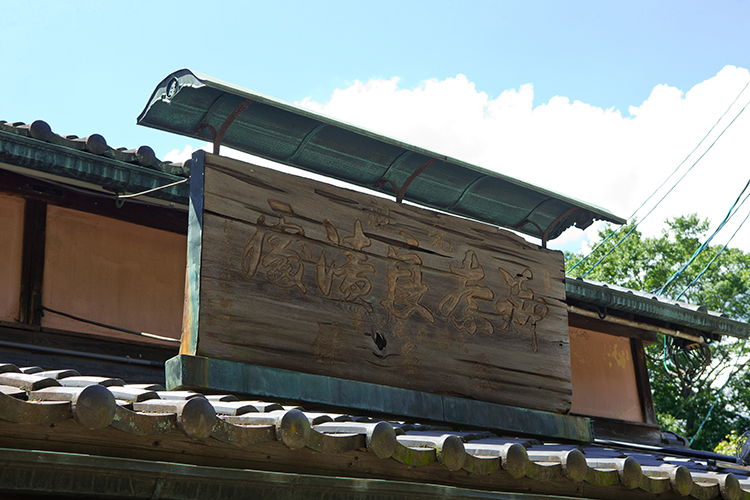
Left: The store’s sign that has been displayed since its founding. Made from a single plank of precious Kasuga-sugi cedar, the sign is so worn that the store’s name is now difficult to read. The characters were originally gilded with gold leaf.
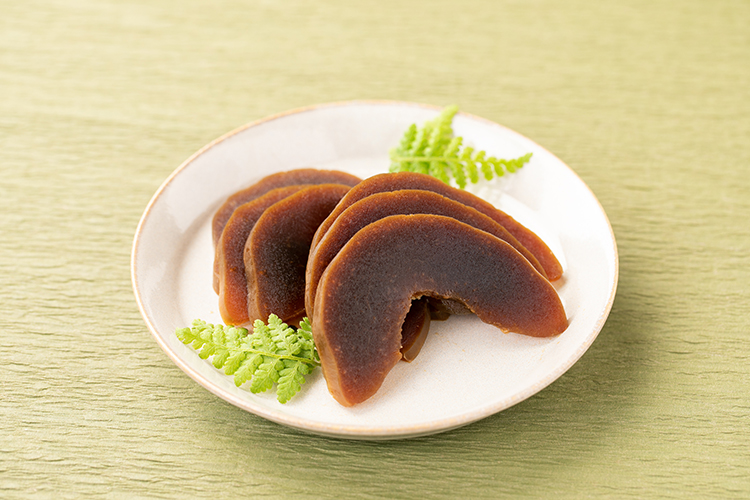
Right: A classic Nara-zuke is shirouri, a white gourd. It provides a satisfying crunch, and the full-bodied flavor of the saké lees blooms in your mouth. It’s perfect as a complement to saké, and when paired with freshly cooked rice, its deliciousness is irresistible.
“Nara-zuke is a fermented food made with saké lees that contains yeast and lactic acid bacteria. It’s said to help regulate gut health and the immune system as well as help brighten and beautify skin. The amber color of Nara-zuke comes from melanoidin, a brown substance formed when amino acids and sugars combine. It has antioxidant properties and can help improve skin conditions. Nara-zuke also contains vitamin B6, which is said to aid skin metabolism.”
Mori herself, Shigeru — her father and previous owner who also greeted us during the interview, and all the staff members working at the store had bright, lustrous skin. It appears their secret is Nara-zuke.
Continuing to preserve these traditional tastes, crafted by artisans’ labor (skills) and patience (time)
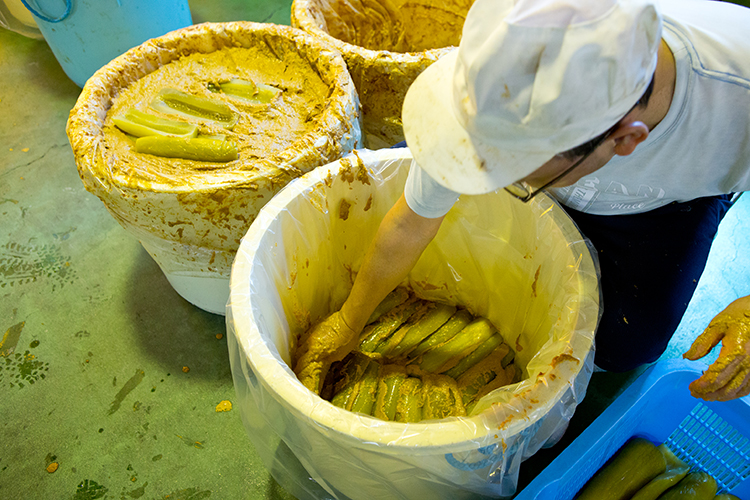
How are Nara-zuke made at Mori Naraduketen?
“Let me explain the process for shirouri. The harvested shirouri undergo a five-step pickling process consisting of (1) salting, (2) initial pickling, (3) second-stage pickling, (4) third-stage pickling, and (5) final pickling. The process takes one to two years before the pickles are finally ready to be shipped. All the steps are done by hand, unchanged from the past.”
1. Salting: Removes the excess moisture from the shirouri
2. Initial pickling: Removes the saltiness from the shirouri (saké lees from the second-stage pickling is reused)
3. Second-stage pickling: Removes more saltiness from the shirouri and adds seasoning (saké lees from the third-stage pickling is reused)
4. Third-stage pickling: Mainly adds seasoning (fresh saké lees is used)
5. Final pickling: Adds the final taste to the Nara-zuke (fresh saké lees is used)
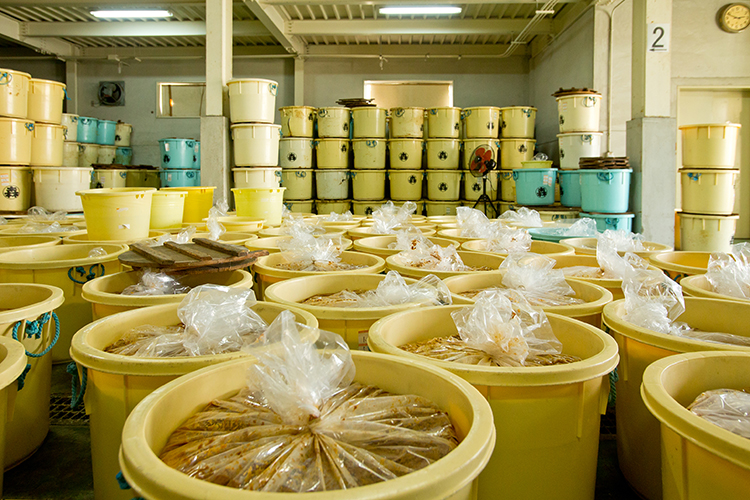
“Saké lees that has been used once (extracted lees) will have absorbed the vegetables’ salt and moisture, but the umami components will remain. So instead of discarding the extracted lees, we reuse them. Through osmosis, the lees draw moisture and salt out of the shirouri while infusing them with umami. We repeat this pickling step multiple times. As we do this, the maturation progresses, which further enhances the umami. We use different mixtures of saké lees and adjust the amount to match the vegetables being pickled and the seasonal conditions. This is why the skills of experienced artisans are crucial in the final two pickling stages. People often speak about the time and effort needed to produce something. In our case, Nara-zuke are crafted by artisans’ labor (skills) and patience (time).
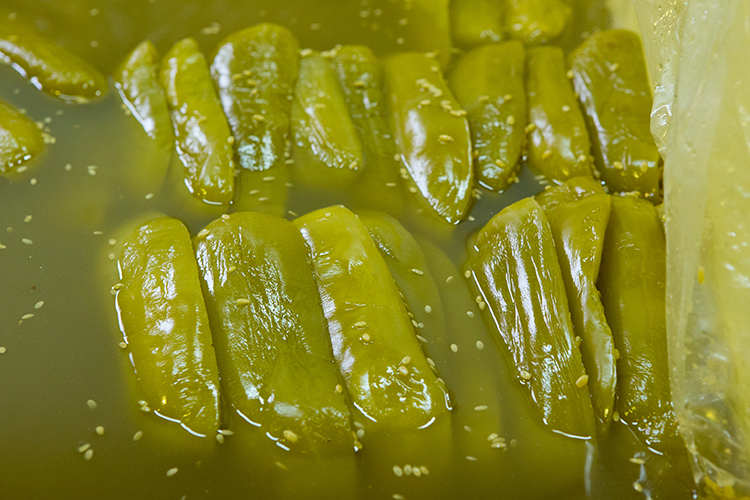
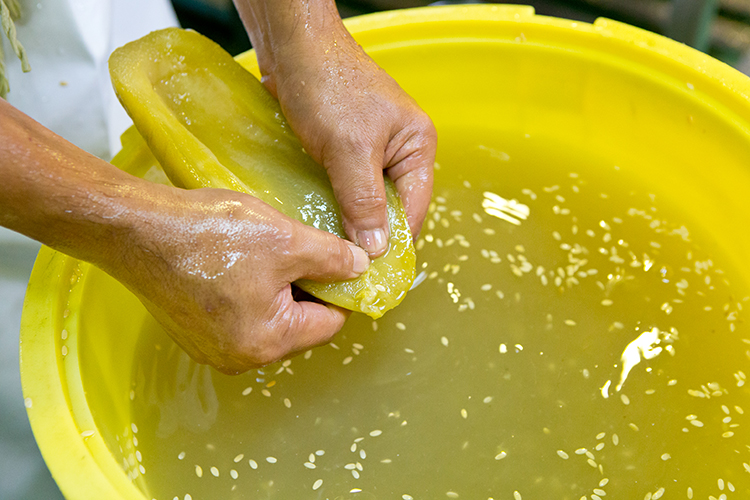
Left: After salting, a significant amount of water is extracted from the shirouri.
Right: The seeds are carefully washed off before proceeding to the next pickling step.
Nara-zuke is truly a world-class sustainable Japanese food, because it not only uses leftover saké lees from saké brewing but also reuses previously used saké lees. Preserving tastes that have been passed down through generations is no simple task.
“We could use imported vegetables and food additives to reduce costs and increase efficiency, but doing so would alter the tastes we’ve prized for generations. Our founder, Mori Tatsu, had a motto: ‘Quality attracts customer without a word’. My mission is to uphold our production methods that have been safeguarded by previous generations, based on the conviction that we compete solely on the taste of our Nara-zuke. Although we do embrace certain changes to adapt to the times — as our predecessors did in switching to plastic barrels and in offering products in more convenient packaging — we have continued to deliver Nara-zuke with the same quality and taste for 150 years. That will never change.”
What surprises people when they see Mori Naraduketen’s products is the sheer variety. Many probably think shirouri and cucumber are the only kinds of Nara-zuke.
“We offer a comparatively large selection of products. Besides shirouri and cucumber, we offer eggplant, watermelon, Japanese sumomo plum, ginger, calabash, chayote, celery, daikon radish, carrot, and others. The sumomo type might be a bit unusual. It’s our original Nara-zuke variety, said to have been conceived by our founder after receiving advice from a monk at Todai-ji.”
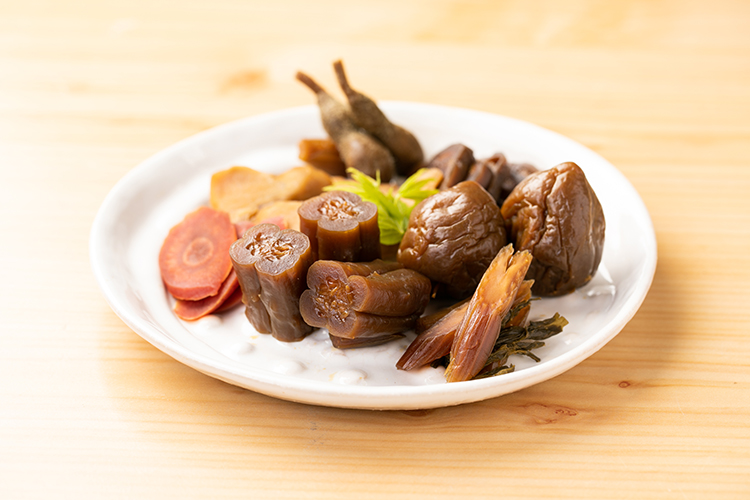
Nara-zuke made with heritage Nara vegetables like the Yamato sanjaku cucumber and Yamato koshoga ginger, as well as the sumomo plum, with its refreshing sourness, soft texture, and deep flavor, have a strong and loyal following
Mori Naraduketen also offers Nara-zuke that use revived local heritage vegetables from Nara.
“My grandfather, our third-generation owner, was always saying ‘Yamato sanjaku cucumbers are truly amazing when made into Nara-zuke.’ They have a crisp bite to them and few seeds, and were cultivated specifically for pickling. However, after the war, Yamato sanjaku cucumbers became scarce because they are long, prone to bending, and difficult to ship. The Nara prefectural government launched a project to support the revival of heritage vegetables, and through a fortunate connection, we began aiding in their cultivation. They were added to our product line during my father’s time as the fourth-generation owner. Later, we started pickling Yamato koshoga ginger. Its exceptionally fine, fibrous texture and uniquely spicy flavor form an addictive taste that we highly recommend.”
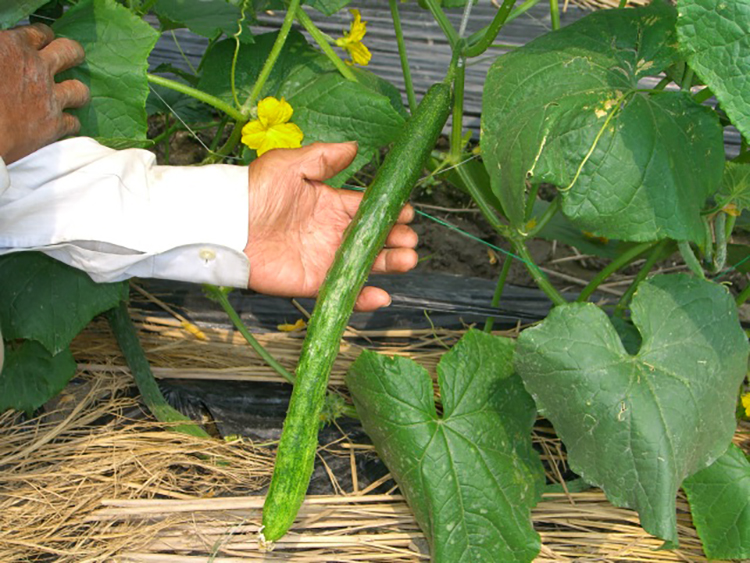
Heritage Yamato sanjaku cucumbers can grow to be over 40 centimeters long, making them challenging for distributors. But the fourth-generation owner, Mori Shigeru, who worked to revive the vegetable says, “These are vegetables born to be pickles.”
Making Nara-zuke more accessible through new forms to enjoy it, so its deliciousness passes on to the next generation
Pickle consumption has declined in Japan by 30 to 40 percent over the past 20 years, according to the Family Income and Expenditure Survey put out by the Ministry of Internal Affairs and Communications’ Statistics Bureau.
“Pickles are always present in our home because it’s our business, but it was also commonplace in our neighborhood for every household to have pickles on the dinner table. If you lived with your grandparents, pickles were often on the table from childhood, and some people even made them at home. It seems the younger generation today doesn’t have many opportunities to eat pickles at home. Some don’t even know what pickles are, and if they’ve tried them, it’s often limited to a few varieties. Pickle consumption doesn’t seem very high.”
Perhaps many people haven’t tried Nara-zuke because of its strong association as something to eat with saké.
“They go well with rice too, so I want more people to try them. I believe the first step is getting people to know the taste, in order to pass them on to the next generation. This is why I designed small packs of Nara-zuke that are easy to enjoy. The selling points of our Nara-zuke PariPori are its manageable portion size and getting two flavors in one. We specifically made the packaging cute to appeal young women. The finished package is also perfect as a travel souvenir.”
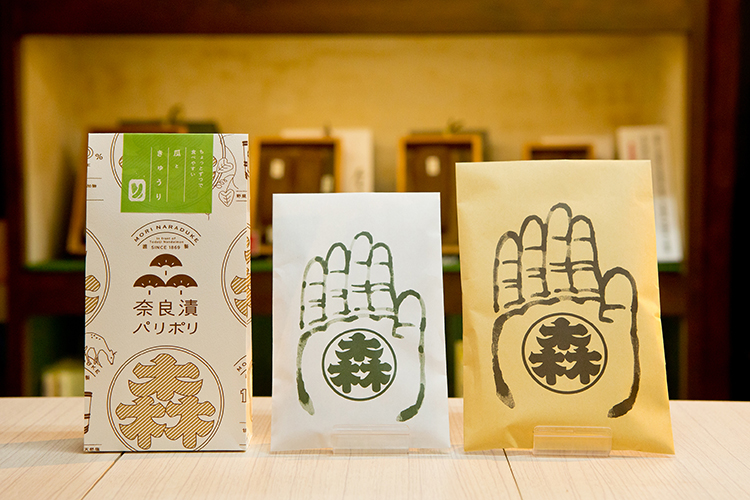
On the left is Nara-Zuke PariPori, containing half a gourd and one cucumber. In the center and on the right are two beloved classic products — both contain chopped Nara-zuke, but differ in volume. The package design with an image of the Great Buddha’s hand is striking. Some customers even specifically ask for the Nara-zuke with the hand.
“Nara-zuke PariPori also solves some waste issues. We inevitably get irregularly shaped Nara-zuke that won’t fit into our standard gift barrels or wooden boxes. We repackage these tasty but rejected pieces into the smaller Nara-zuke PariPori packages, which we offer at a lower price.”
Mori is active on social media, sharing new ways to enjoy Nara-zuke, along with the history of Nara-zuke, local Nara events, and scenes of Nara’s four seasons.
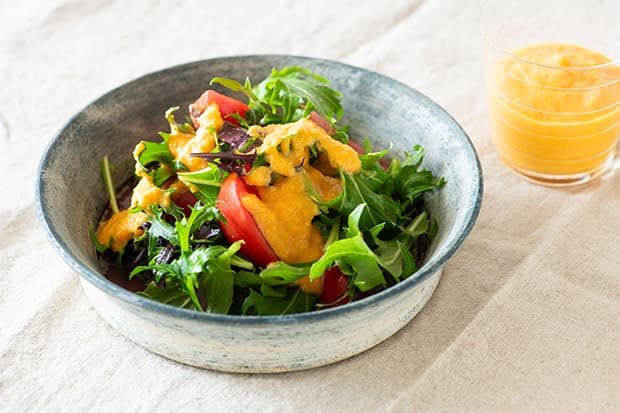
“Unlike the past, what and how we eat has diversified. So Nara-zuke is not just for rice or saké anymore; they go well with bread and pasta too. By dispelling old expectations and encouraging creative variations, I hope to get more people — from kids to adults — to enjoy Nara-zuke. That’s why I share recipe ideas like potato salad with Nara-zuke, Nara-zuke cheese toast, or carpaccio with a dressing made with the saké lees leftover from Nara-zuke. All are simple, easy-to-recreate recipes. Feel free to make them in your own style — they’re sure to be delicious.”
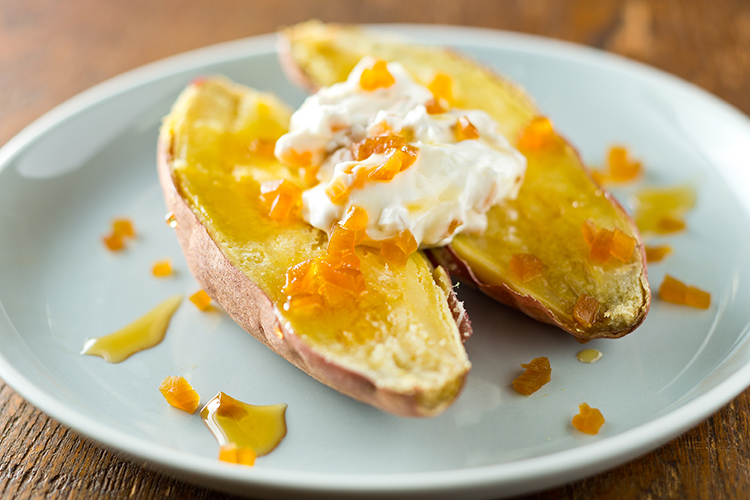
The alcohol in the Nara-zuke blends with the mascarpone for a mellow, easy-to-eat taste. The sweet-salty flavor is so delicious, it’s addictive.
Mori’s latest creation is Baked Sweet Potato with Nara-zuke Mascarpone. Spoon some mascarpone on a baked sweet potato and top with chopped Nara-zuke and you’re done. Add maple syrup if you like. The sweetness of the potato, the richness of the mascarpone, and the Nara-zuke’s saltiness and umami. When you factor in the rich aroma, the deliciousness is endless. The key is using mascarpone instead of cream cheese.
Fermentation culture is borderless! I want to enliven pickling culture as a whole, not just Nara-zuke
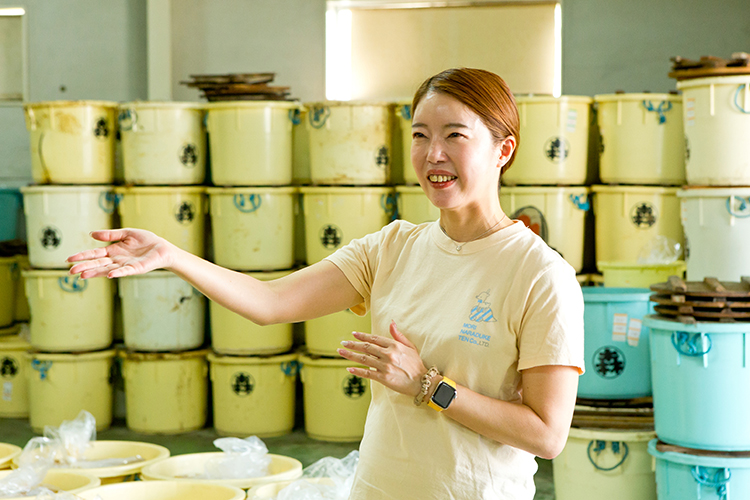
Mori often travels overseas. She has exhibited at saké festivals in Australia as well as gone on business missions and tours in France, Uzbekistan, Poland, the Czech Republic, China, and other countries. She’s incredibly curious and always ready to go and experience local fermentation cultures in person.
“I’ve exhibited at saké festivals in Australia several times. People in other countries know nothing about Nara-zuke. Finding the right English wording is tricky. Calling them pickles makes it sound like vegetables pickled in vinegar. So I explain that Nara-zuke means saké pickles. When I serve them with cheese rather than on their own, people love them. ‘This is so delicious. This would go great with drinks.’ I ask people who sample our Nara-zuke what kind of food they would pair with Nara-zuke. Sometimes I get interesting suggestions like, ‘I might put it in the blender and make it into a dip.’
“Every country has its own fermentation culture. I visited Poland this summer, where they add pickles to soup. It’s a bit surprising, but the added acidity and umami, plus the textural accent, turns out to be delicious. You are very unlikely to discover such ways to enjoy fermented foods unless you go to these local areas. I’m purely interested in fermentation cultures, and I find learning about them enjoyable. Conversely, I want Japan’s fermentation culture to be more widely known worldwide. That’s why I’m more than willing to join any learning or exchange opportunities related to fermentation, at home or abroad, whenever my schedule allows.”
“Fermentation culture knows no borders. I want to see the entire pickling industry, not just Nara-zuke, be revitalized and thrive. I regard other types of pickles as relatives, and all of Japan’s fermentation culture as companions. And I feel connected to fermentation cultures in other countries too. When I visit them on business tours, it feels like going to see distant relatives. With fermentation culture as a common ground, we take an interest in each other and can talk about many things, which shrinks the distance between us.”
Mori strives to preserve traditional tastes, even as she uses her free creativity to bring new ideas to life. She attributes her drive to the inspiration gained from visiting various places and attending events and lectures, saying it’s all thanks to the connections she’s made.
“Having done business in Nara for so many years, I have a strong desire to invigorate my local community along with Nara-zuke. I hope to cross business barriers, join hands with all kinds of people, and create something new together.”
With so many ideas she wants to pursue, Mori says she needs multiple bodies. Given that both fermentation culture and local pride know no borders, she is certain to continue her energetic endeavors.