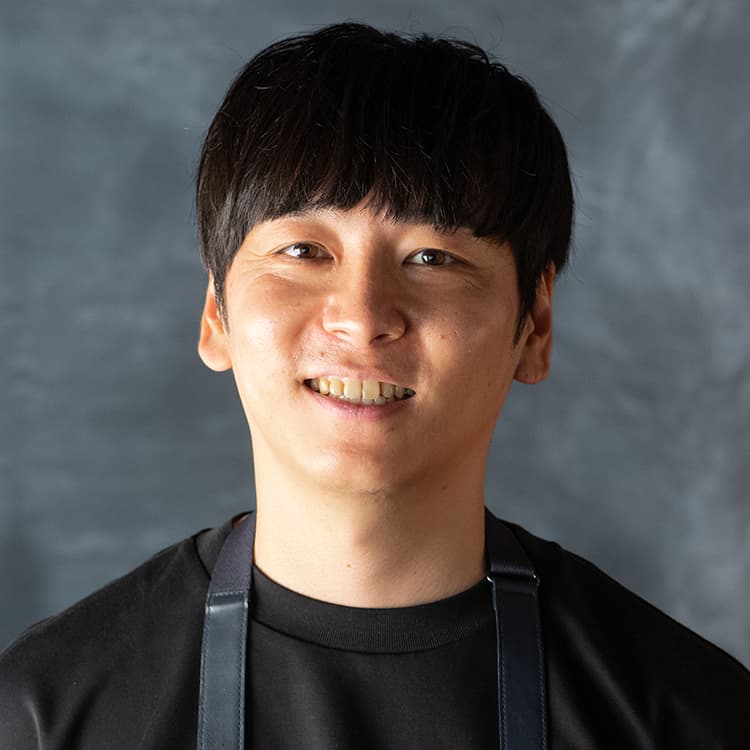
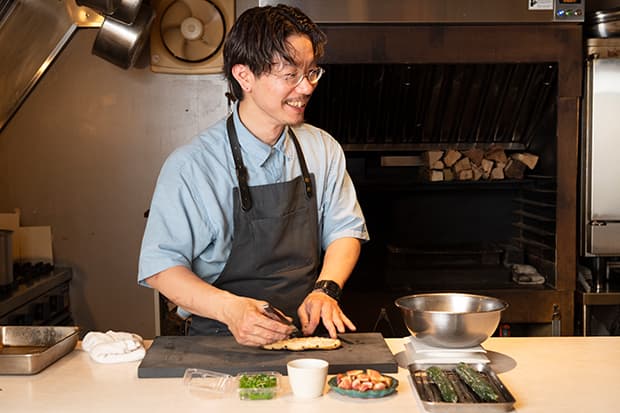
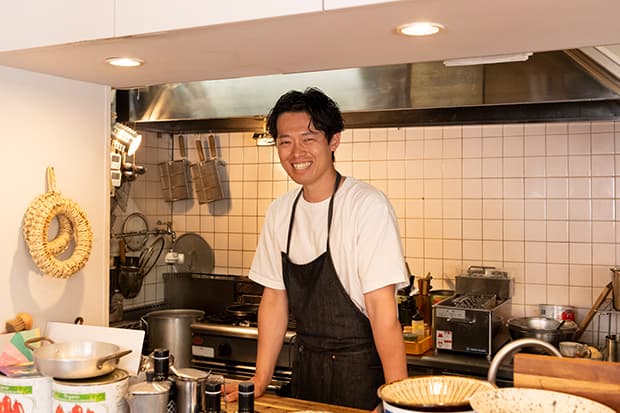
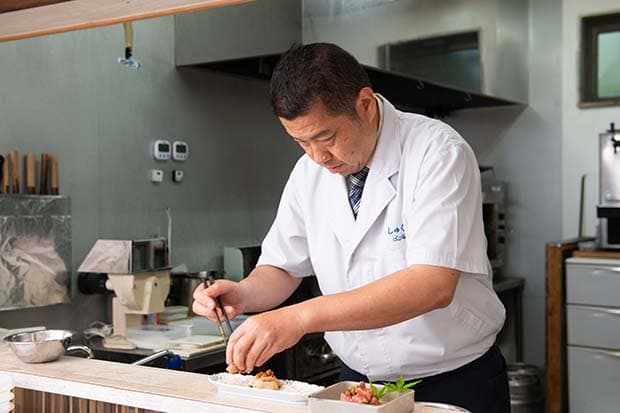
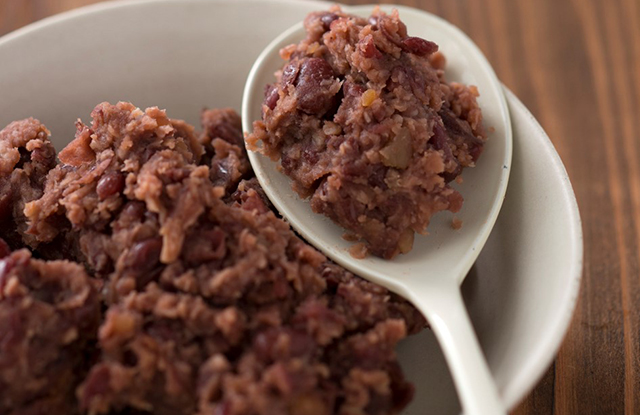
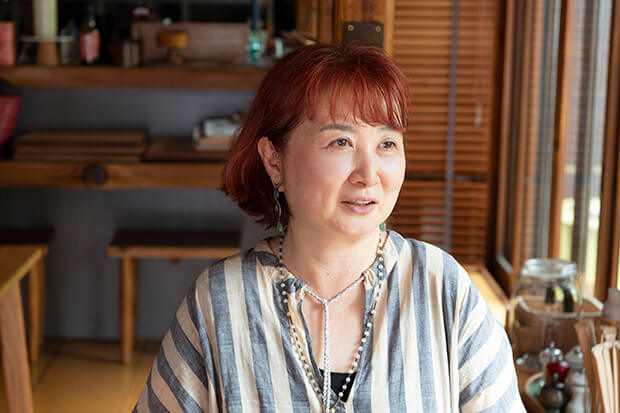
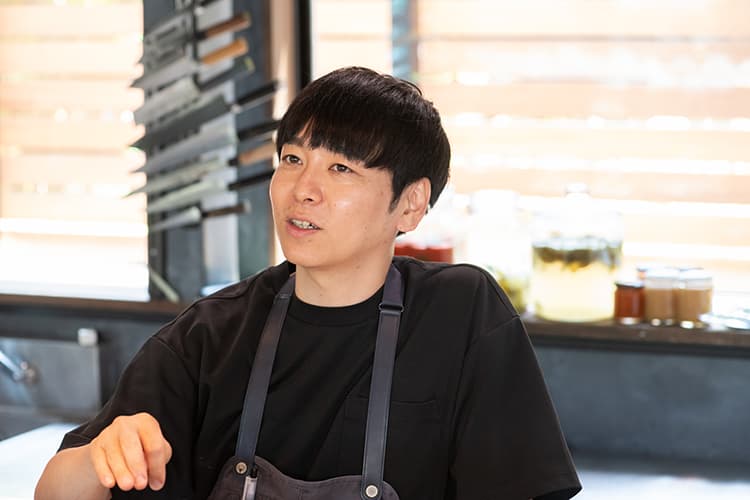
The Tasty Fermentation Club is an ongoing series where we ask food professionals for their top recommended fermented foods. This time we spoke with Fujii Takumi, head chef at enso hanare, a restaurant developed by the Osaji cosmetics brand that specializes in sensitive-skin products.
Fueled by endless passion and curiosity about fermentation, Fujii has become known in the industry, variously, as the Fermentation Prince, the Fermentation Maniac, and even the Fermentation Freak. His choice dish is fermented yellowtail and daikon radish, a surprising and involved fermented dish made by combining yellowtail, grated daikon, and salt.
Let’s dive into the depths of Fujii’s world of fermentation, where he deconstructs familiar dishes and reconstructs them through fermentation.
Recognizing his own cooking style at a restaurant that became known for its fermented offerings
If you head straight out from the west exit of Kamakura Station, you’ll eventually spot a restaurant with rows of preserving jars lining its bay window. This is enso hanare. The restaurant’s predecessor, enso, was regrettably shuttered for good in the summer of 2025 due to the dilapidated condition of its building. It will reopen as enso hanare [literally, the annex of enso] in a new location in the fall of 2026.
Backing enso hanare is the well-known skincare brand Osaji. The brand’s expansion into the restaurant business was driven by its core belief that skin health depends equally on the application of external care products and on emotional well-being and nutrition.
“The restaurant’s name ‘enso’ has several meanings baked into it, but the one I like is ‘performance’. To perform on a musical instrument, you first tune it to be in pitch. In the same way, we want enso to be a place where guests can tune up their well-being and happiness.”
The former enso restaurant opened around four years ago, but it did not start out as a restaurant specializing in fermented dishes. Only after hearing guests say things like, “This must be a fermentation restaurant” and “The fermented dishes here are fantastic”, did Fujii recognize the merits of his own cooking style.
“If you ask me whether I’ve mastered authentic French cooking, the answer is definitely no. So, I decided to let that ambition go and instead ask myself, ‘What is it that only I can make?’ My identity now has become preparing homemade fermented ingredients and creating dishes you can only taste here.”
Continuously seeking the what and why of fermentation
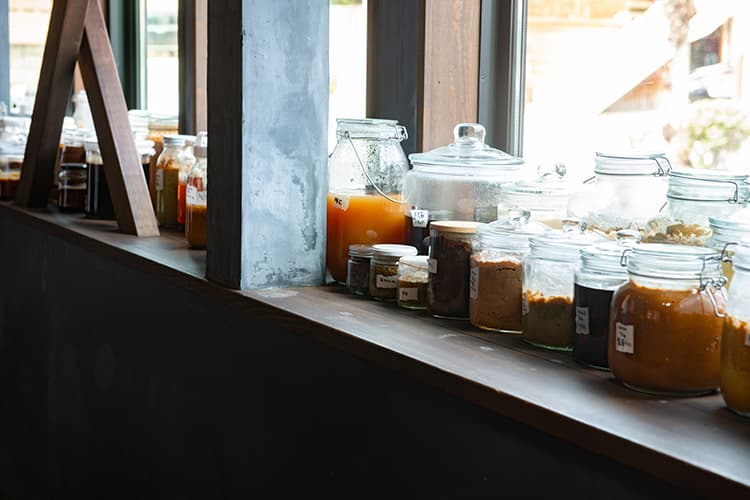
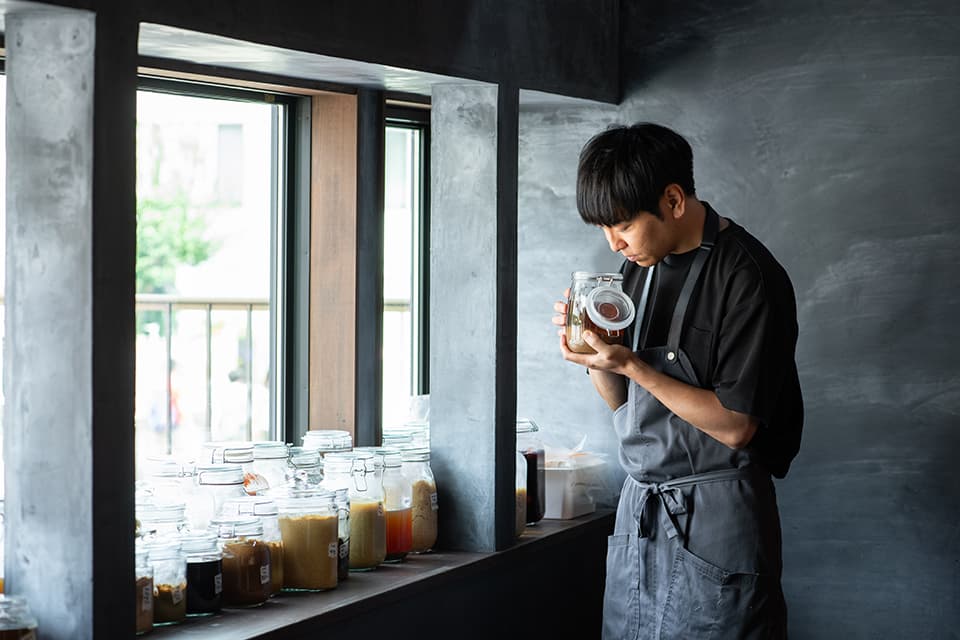
Rows of homemade fermented ingredients line the window
During the restaurant’s nearly yearlong hiatus, Fujii never stopped exploring fermentation and experimenting with it. His collection of homemade fermented ingredients has ballooned to over 100 varieties, as he developed new ingredients during the break while continuing to nurture those from the previous restaurant.
Besides ordinary fermented ingredients prepared from vegetables, beans, and fruits, his collection includes fermented ingredients from fish, meat, and milk. The rows of preserving jars in the windowsill make the place look like a fermentation laboratory. One can’t help but be awestruck by the breadth of Fujii’s creativity and the sheer number of ingredients he has come up with.
“If you are content with staying in the kitchen, you’ll never know what goes on in the invisible world of fermentation. Fermentation enhances the sweetness and umami flavor of ingredients. This enhancement is obvious to the senses, but what I want to know is why it happens. Once you develop an understanding of the principles of fermentation, you can apply your creativity to ferment many other ingredients.”
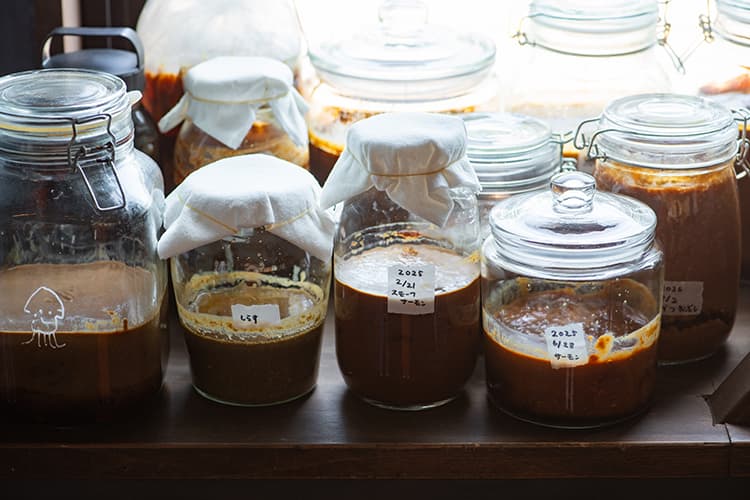
A section of Fujii’s collection showcasing fermented seafood ingredients, including squid, whitebait, and smoked salmon
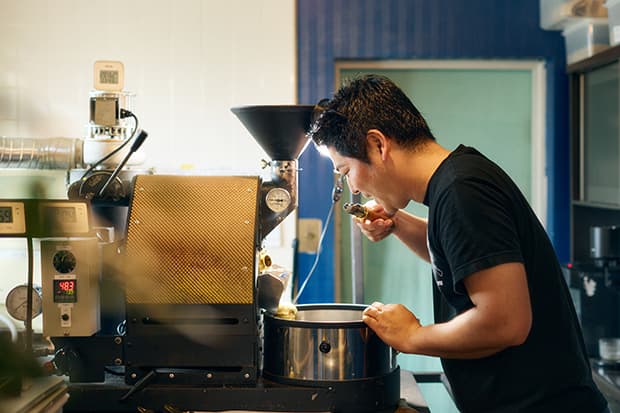
Fujii explores the fermentation potential of each ingredient while consulting books and academic papers on fermentation to verify the functions and behavior of the microorganisms and enzymes. He constantly questions his processes: “Is this really fermenting?” “What types of microorganisms or enzymes are active?” “What are they metabolizing and how is this changing the original ingredients?”
He goes back to the foundational principles for each phenomenon and applies the understanding he gains to his next fermentation experiment or dish. This cumulative process of inquiry has led to the creation of over 100 varieties of homemade fermented ingredients.
Fujii’s yellowtail daikon eschews simmering; taking two to three years to prepare
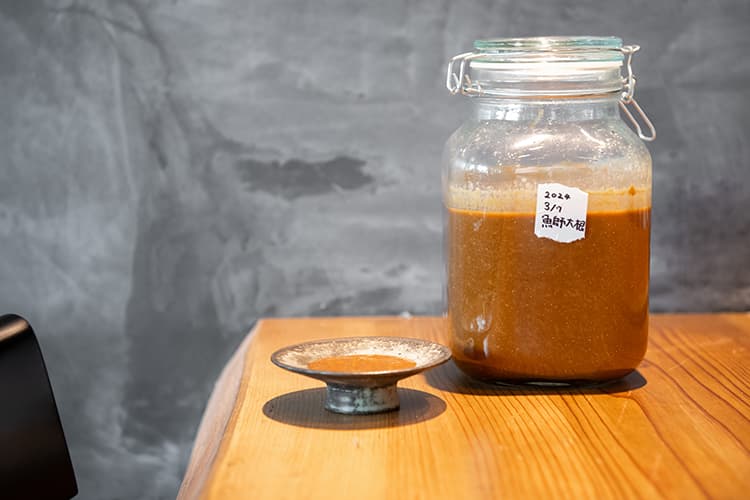
Given how inquiring he is, it was notable that Fujii decided to share his fermented yellowtail daikon as his top pick.
For many people, yellowtail daikon brings up images of that winter classic of yellowtail and daikon simmered in a sweet-and-savory sauce. However, you’ll find neither simmered yellowtail nor daikon soaked in broth in Fujii’s fermented yellowtail daikon.
How to make Fujii’s fermented yellowtail daikon
-
- Ingredients (easy-to-prepare amount)
- 1000 grams of yellowtail flesh and innards
- 200 grams of grated daikon
- Salt equal to 15% of the total weight of the other ingredients
-
- Directions
- 1.Remove the yellowtail’s head, fillet the remainder into three pieces, wash thoroughly, and pat until completely dry. Remove the bones, fins, and skin, and then finely chop the flesh. Set the innards aside.
- 2.Place the yellowtail flesh and innards from Step 1, the grated daikon, and the salt in a sterilized, airtight storage jar, and mix well.
- 3.Cover the surface tightly with plastic wrap to minimize air exposure, and then secure the lid. Store in a well-ventilated area away from direct sunlight and allow to ferment and mature for two to three years.
- Important:It is imperative to follow strict hygiene management with long-term fermentation that involves raw seafood and internal organs. If you discover any abnormalities, such as mold or foul odors, do not eat or taste the mixture. Discard it immediately.
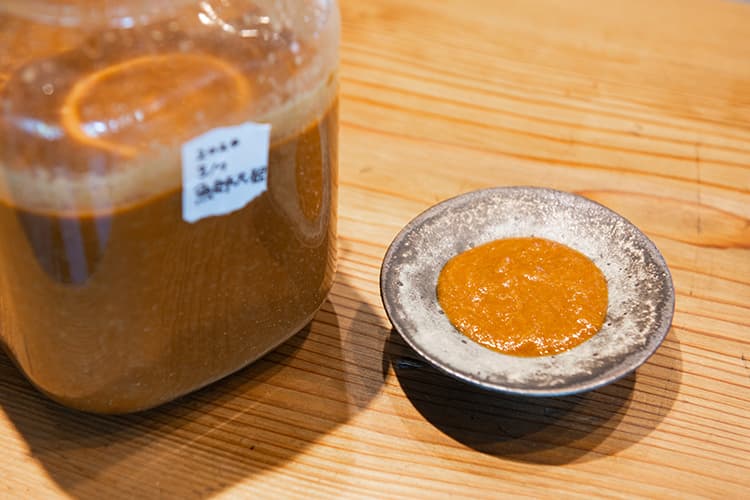
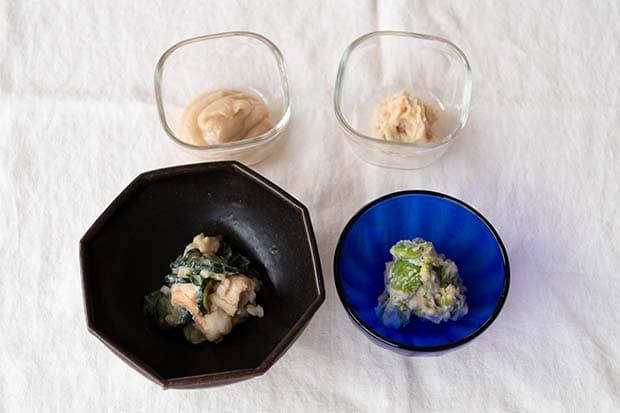
As the fermentation progresses, enzymes and microorganisms contained in the innards become active and break down the protein in the yellowtail. The mixture gradually turns into a miso-like paste and develops a deep, rich umami.
“Many people likely imagine fermented fish having a distinctive aroma or a strong, acquired taste. On the contrary, this fermented yellowtail daikon has no fishy smell, no strong sourness, and no overpowering aroma. Nevertheless, you still get the yellowtail’s rich umami that blossoms slowly throughout the mouth and the sensation of the daikon’s subtle, refreshing sweetness. And because the proteins have been broken down into fine particles, the paste doesn’t chunk up when hot water is poured over it. Instead, it dissolves smoothly just like miso.”
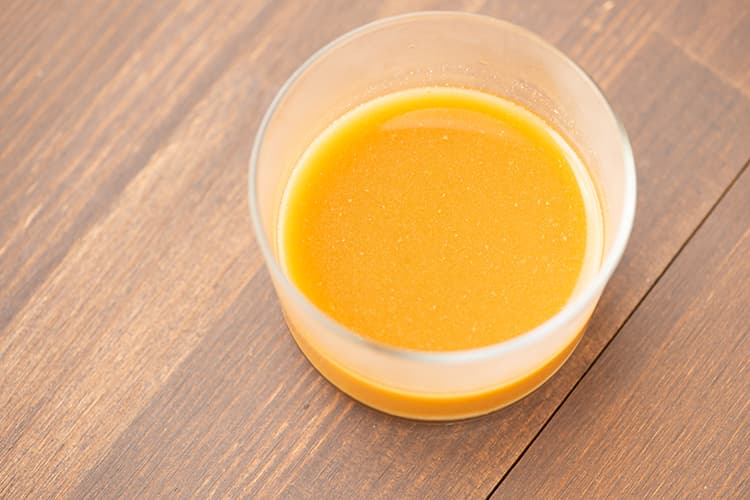
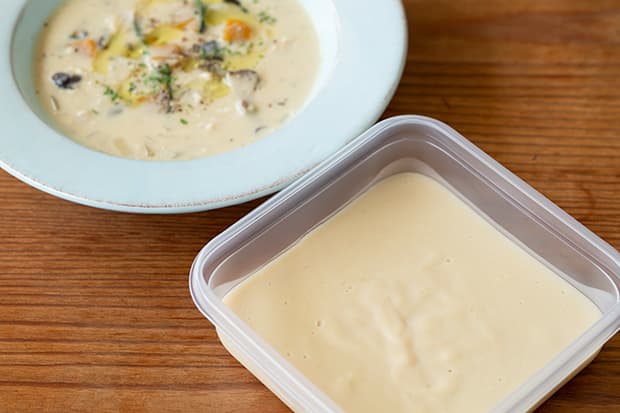
Adding hot water to the fermented yellowtail daikon turns it into a miso soup that is as flavorful as it looks
Transforming the yellowtail daikon from memories into new dishes
“The idea of fermenting yellowtail with grated daikon came from the dish yellowtail daikon. The concept itself felt completely natural to me. However, figuring out how to use the resulting fermented yellowtail daikon seasoning in my cooking presented a whole different set of challenges.”
The approach Fujii took was to isolate and reexamine each element that constitutes the essence of yellowtail daikon: the daikon and its salty-sweet broth, the yellowtail, and the accompanying garnishes. This let him reconstruct a brand-new version of yellowtail daikon — centered on a dashi broth from daikon and yellowtail and his fermented yellowtail daikon seasoning — that honors the quintessential flavors and aromas associated with memories of traditional yellowtail daikon.
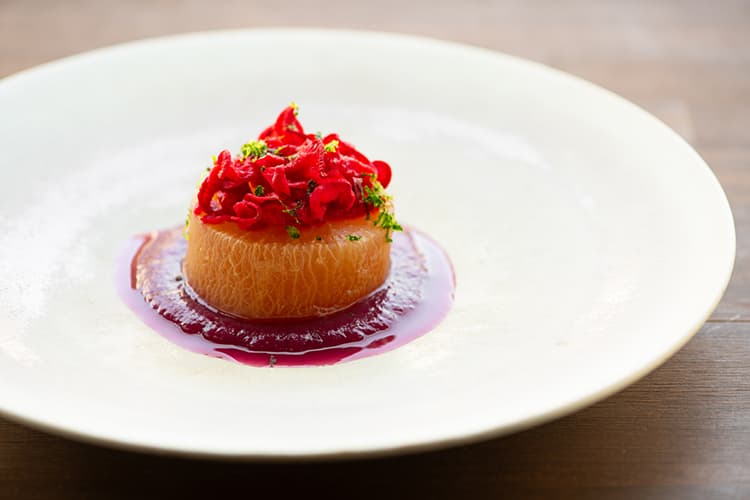
Although Fujii’s yellowtail daikon doesn’t resemble yellowtail in any way, the impact of its umami is unmistakable
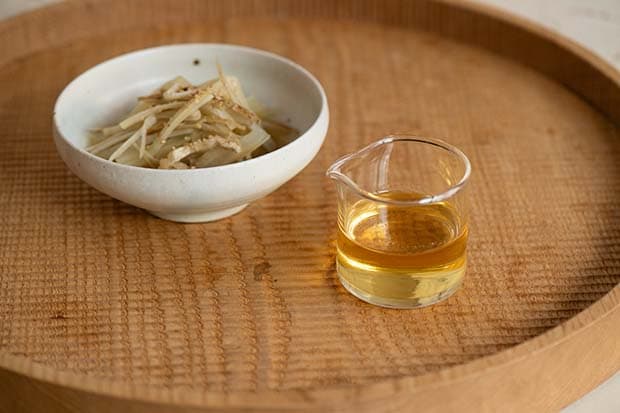
Thick slices of daikon, colored a pale amber, are slowly infused with dashi made from yellowtail bones and the umami of the fermented yellowtail daikon. Gently layered on top like flower petals are slices of vibrant red daikon that have been fermented and then dried. They are then rehydrated with a dashi infused with ginger and yuzu citrus to provide a delightful crunchy texture and aromatic accent. The final reddish-purple sauce flowing out over the plate is made by combining roasted red daikon with broth from the yellowtail.
“The fermented yellowtail daikon seasoning contains both yellowtail and daikon, so using it in a meat dish just doesn’t feel quite right to me. When I combine ingredients, I look for a sense of necessity and consistency. With this dish, my aim was to create something that while reminiscent of the yellowtail daikon I remember is also a completely new take on it.”
Fermentation gives ingredients a narrative
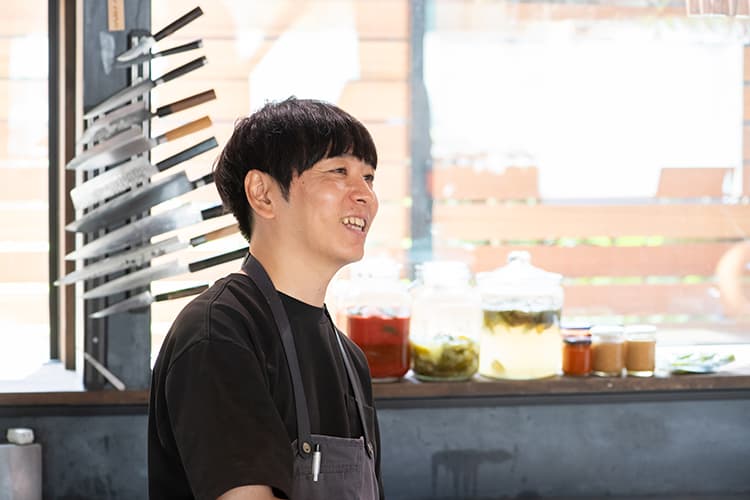
“At enso hanare, we strive to serve dishes that nourish both the mind and body. My aim is to offer a dining experience after which your stomach still feels light, even though you are full.”
Fujii’s cooking stars fresh vegetables and seafood sourced in Kamakura. You won’t find luxury ingredients like foie gras or caviar here. However, the time and effort he devotes to these commonplace ingredients set his cuisine apart from home cooking. A prime example are his homemade fermented ingredients, which slowly transform over time.
“It’s not that I want to devise dishes simply to take advantage of my homemade fermented ingredients. Neither is it my goal to make dishes where people think, ‘I’m not quite sure what this is, but it tastes good’. Instead, I want to create dishes where diners have a shared image of what to expect just from the names on the menu, such as yellowtail daikon, corn potage, and carrot steak. At the same time, fermentation plays a huge role in my cooking methods that, frankly, no one has ever seen before. That’s the kind of cuisine I aspire to create.”
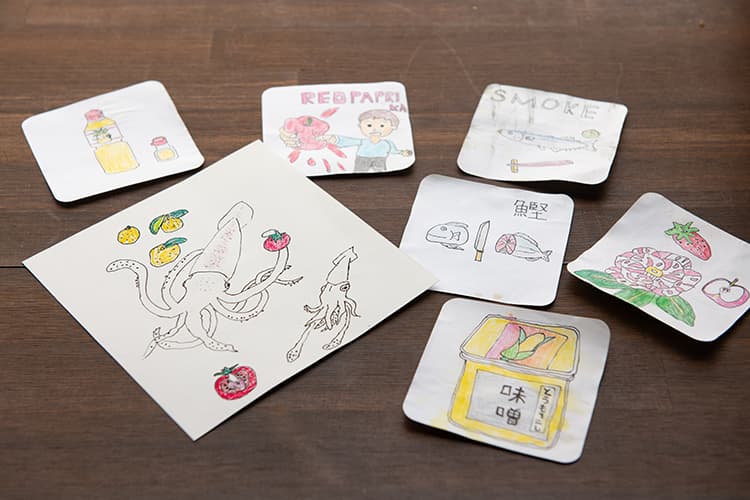
Some of the hand-drawn labels Fujii sticks on his jars of fermented ingredients. They indicate the combination of ingredients in the jar as well as suggest a playful story.
An example of Fujii’s out-of-the-box thinking is ice cream made with fermented corn. The power of fermentation converts the corn’s starch into sweetness, enabling him to create ice cream with a smooth mouthfeel, rich sweetness, and fresh aroma, all without using any sugar or dairy products.
Another example is a dish that pairs fresh fall-run bonito with a fermented paste made from the first bonito of the season prepared in early summer. Through fermentation, Fujii brings different seasonal flavors together on a single plate, resulting in a dish where you can savor layers of time.
Fermentation does more than just alter the flavor and form of ingredients. It freezes time, spans seasons, and lends familiar dishes fresh narratives. Fujii’s cuisine breathes with this transformational power of fermentation.
Next, our baton will pass from Fujii Takumi to Maison Olina, a French restaurant housed in a private residence in Kamata, Tokyo. Please look forward to the choice fermented dishes from Chef Olivier Garcia and Natsuko Takato.